The most common reason businesses fall behind on content isn't lack of ideas — it's the exhausting cycle of creating everything from scratch. A blog post takes four hours. A Reel takes two. An email newsletter takes another hour. Multiply this across all channels, every week, and it becomes unsustainable.
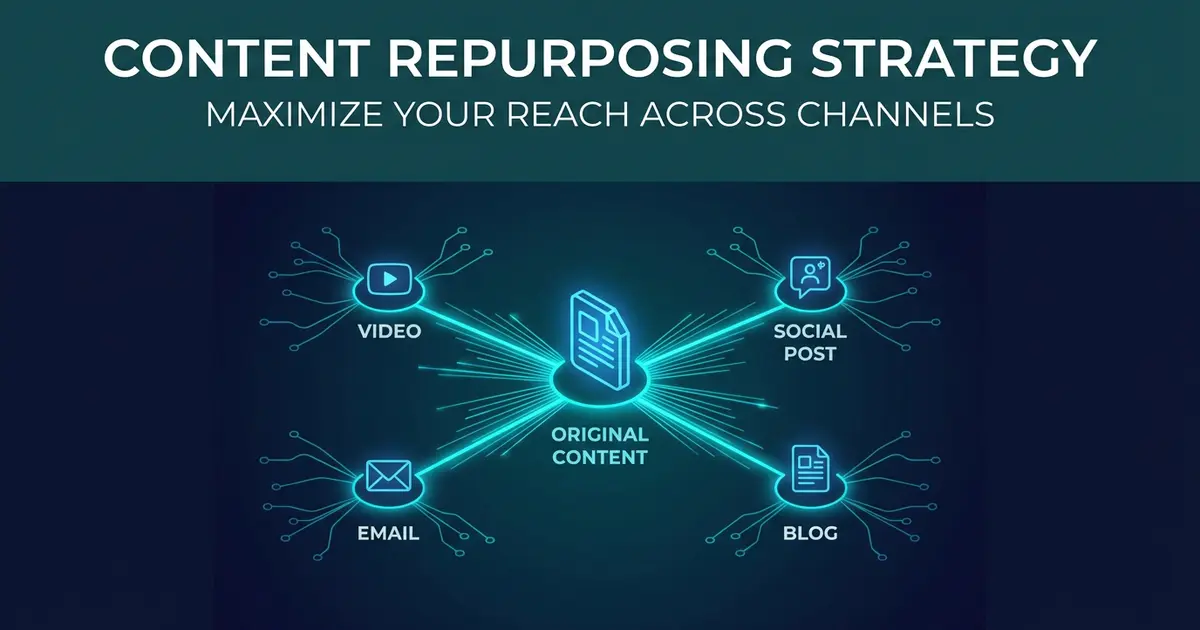
Content repurposing breaks this cycle. It's the practice of taking one core piece of content and systematically adapting it into multiple formats for different channels. Done well, a single long-form piece — a detailed blog post, a podcast episode, a webinar — becomes a week's worth of content across social media, email, and video. You create less, publish more, and reach people in the format they prefer.
Repurposing works best when you start with long-form "pillar" content — substantive pieces that contain enough depth to be broken into smaller formats. A 1,500-word article, a 30-minute podcast, or a comprehensive how-to video are all good pillars. A two-sentence social media caption is not — there's nothing there to extract.
The ideal pillar content addresses a significant question or problem for your audience, contains multiple distinct points or sections, and is genuinely useful as a standalone piece. If your article wouldn't work on its own, it won't repurpose well either.
Every pillar piece of content can be systematically broken down into derivative formats. Here's how a single long-form blog post generates a week of content:
The biggest mistake in content repurposing is copy-pasting across platforms. A paragraph from your blog posted word-for-word on Instagram will perform poorly — not because the content is bad, but because the format is wrong. Instagram captions are conversational and hook-driven. LinkedIn posts are formatted with line breaks for scannability. Twitter/X threads are punchy and sequential. Each platform has a native content culture; effective repurposing adapts your core message to fit it.
Repurposing isn't copy-pasting. It's translation — the same message, rewritten for a different audience expectation and consumption context.
The efficiency gains from repurposing multiply when you batch the work. After writing a blog post, immediately block 90 minutes to extract all derivative formats before moving on. This is faster than returning to old content cold. You're already in the headspace of that topic, the key points are fresh, and the extraction process flows naturally.
Build this into your content workflow as a non-negotiable step: pillar creation is done when the repurposed formats are queued, not when the original is published.
Not all content repurposes equally. Time-sensitive content — news, trends, current events — loses its repurposing value quickly. Evergreen content — foundational principles, how-to guides, frameworks — can be repurposed repeatedly over months or years. A strong evergreen piece published today can still be repurposed six months from now, reaching new audience segments who weren't following you when it was first published.
Content repurposing is not a shortcut — it's a smarter system. Build your content around substantive pillar pieces, extract multiple formats from each one, adapt each format natively for its platform, and batch the work for efficiency. The result is more consistent publishing, less creative burnout, and a content presence that compounds over time rather than exhausting you every week.
We build content systems and manage ongoing content creation for businesses that want to publish consistently without the overhead.
Talk to us