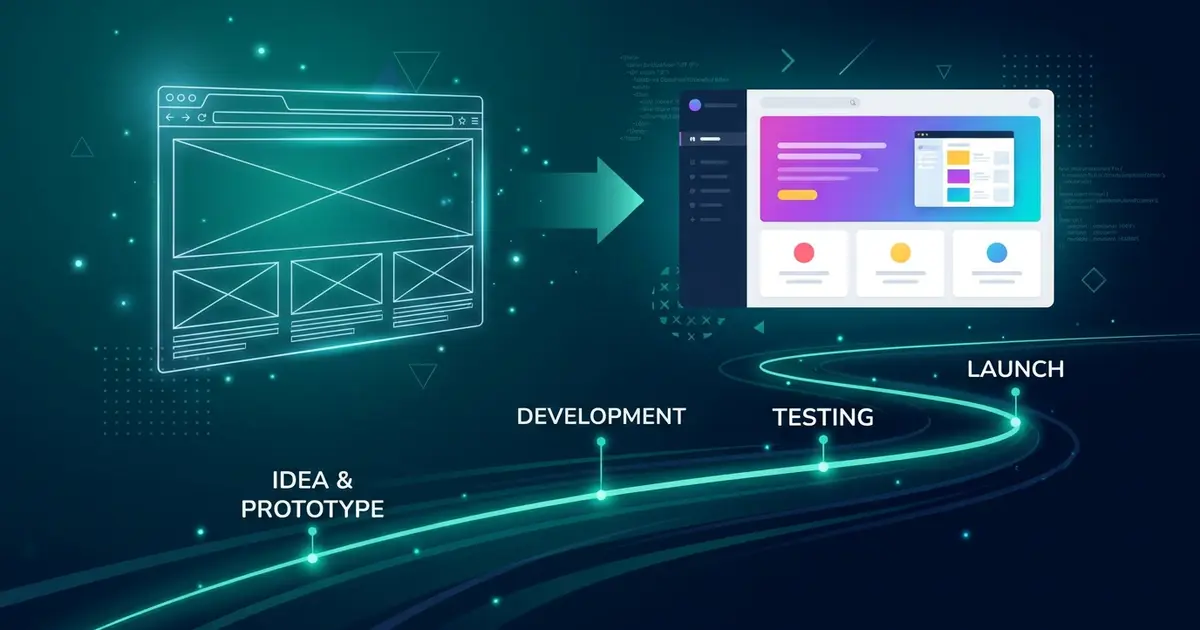
The term "minimum viable product" is one of the most misunderstood phrases in startup and software culture. Founders either treat it as an excuse to ship something half-finished and unpolished, or they panic and add features until their MVP is as complex as the full product. Both approaches waste money and delay the answer to the only question that matters: will real people pay for this?
A true MVP is the smallest version of your product that can deliver the core value proposition to a real user and generate real feedback. It's not a prototype, it's not a slide deck, and it's not a product with 80% of its intended features. It's a deliberately scoped, launchable product that tests your riskiest assumption.
Before writing a single line of code or designing a single screen, write down the core hypothesis your MVP needs to test. A good hypothesis follows this format: "We believe [target user] will [do this behaviour] because [this value proposition]. We'll know we're right if [measurable outcome]."
For example: "We believe Lebanese restaurant owners will pay a monthly subscription to receive automated WhatsApp order confirmations, because phone calls interrupt service. We'll know we're right if 10 out of our first 50 beta users convert to paid within 30 days."
Everything in your MVP scope should exist to test this hypothesis. Features that don't contribute to proving or disproving it belong in version 2.
Scoping is the hardest part. Start by listing every feature you think the product needs. Then categorise each one: must-have (the MVP is useless without this), nice-to-have (improves experience but not essential), and future (needed for scale, not launch).
A common MVP mistake is building infrastructure that already exists as a service. Authentication, payments, email, SMS, storage, scheduling — there are mature, affordable third-party solutions for all of these. Your MVP should be built on proven primitives so your team's limited capacity focuses on the unique logic that constitutes your actual product.
Building an MVP is an exercise in identifying what only you can build — and using everything else off the shelf. Differentiation comes from your core logic, not your authentication system.
Your MVP is only as valuable as the feedback it generates. Before you launch, design your feedback collection system: who will you talk to, how often, what questions will you ask, and what signals will you track in the product? User interviews are more valuable than analytics at the MVP stage — you want to understand the why behind behaviour, not just observe it.
Define your success metrics in advance. If you don't know what a successful MVP looks like before you launch, you'll rationalise any result as validating your idea. Common MVP success metrics include activation rate (did users complete the core workflow?), retention (did they come back?), and conversion from free to paid.
A properly scoped MVP for a B2B SaaS product typically takes 6–12 weeks with a small, experienced team (one developer, one designer, one product owner). Consumer apps with more UX complexity might take 10–16 weeks. If your MVP is taking longer than four months to build, it's almost certainly not minimum anymore. Go back to the scope and cut.
A successful MVP isn't the product you're proud of — it's the product that answers your most important question as quickly and cheaply as possible. Define your hypothesis clearly, scope ruthlessly to the core flow, use off-the-shelf infrastructure, and design your feedback system before you launch. The insights you gain from a real MVP in 8 weeks are worth more than a perfect product in 18 months.
We design and develop MVPs for startups and businesses — scoped correctly from day one, built to test and iterate fast.
Talk to us