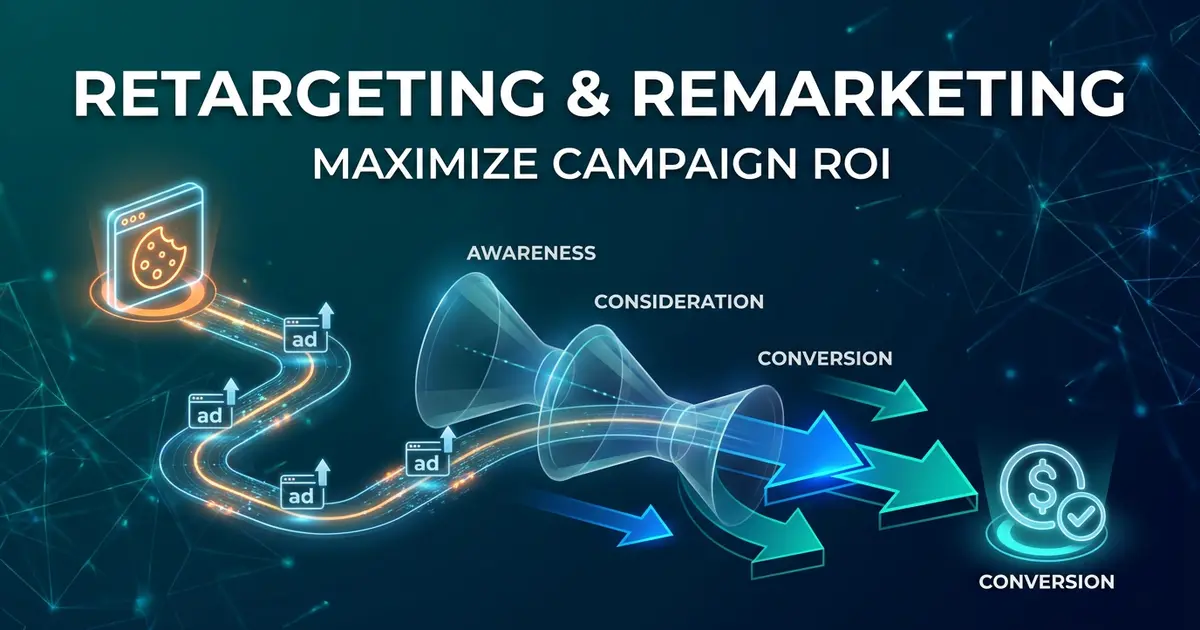
Ninety-seven percent of website visitors leave without converting. They read your page, looked at your pricing, maybe spent three minutes on your portfolio — and then they closed the tab. Without retargeting, that's the end of the relationship. With it, you can follow those visitors with relevant ads that bring them back when they're ready to act.
Retargeting is consistently one of the highest-ROI advertising tactics available, because you're showing ads to people who already know who you are. The hard work of building initial awareness is done. The retargeting campaign's job is to maintain visibility, overcome objections, and create the right nudge at the right moment.
Retargeting works by placing a tracking pixel on your website (Meta Pixel for Facebook/Instagram, Google Tag for Google Ads). When visitors land on your site, the pixel fires and adds them to a custom audience. Your ad platform can then serve ads specifically to those people across social media, YouTube, Gmail, and partner websites.
The major shift in recent years has been the increased importance of first-party data. With browser privacy restrictions reducing cookie reliability, pixel-based retargeting now supplements with customer list matching — uploading email lists to Meta or Google to reach your contacts directly. The most sophisticated retargeting setups in 2026 combine pixel audiences, customer lists, and Conversions API (server-side tracking) for the most complete view of your funnel.
Not all website visitors are equal. Someone who spent 8 minutes reading your services page and then viewed your pricing is far closer to buying than someone who bounced from your homepage after 10 seconds. Retargeting works best when you mirror this intent in how you segment and message your audiences.
The most common mistake in retargeting is running the same ad creative used in prospecting campaigns. Retargeting audiences already know your brand — showing them a generic awareness ad is a wasted impression. Retargeting creative should do two things: acknowledge familiarity implicitly (speak as if to someone who's already visited) and address the specific objections that typically prevent conversion.
Testimonials and case studies are highly effective at the middle and lower funnel — they provide the social proof that hesitant prospects need. Comparison messaging ("Here's what makes us different") works for high-intent audiences sitting between you and a competitor. Urgency and scarcity ("Limited spaces this month," "Quote valid for 7 days") work best for the highest-intent segments like pricing page visitors or cart abandoners.
Retargeting isn't about following people around the internet — it's about staying visible to people who have already expressed interest, and giving them what they need to make a decision.
Over-retargeting is a real problem. Showing the same ad to the same person ten times in a week doesn't build trust — it builds resentment. Set frequency caps in your ad platform (typically no more than three to five impressions per person per week). Rotate creative regularly so that frequent viewers see something fresh. And always exclude people who have already converted — nothing damages trust like showing a new user offer to someone who just became a client.
The standard retargeting window is 30 days, but this varies significantly by industry and buying cycle. A SaaS product with a long evaluation cycle might retarget for 90 days. An e-commerce store with impulse purchase products might find 7 days performs better. Test your retargeting window against your actual sales cycle length — the goal is to stay visible while interest is still warm, not to haunt people who visited your site six months ago and moved on.
Retargeting turns your advertising spend from a one-shot opportunity into an ongoing conversation with prospects at every stage of their decision process. Set up your pixels and tracking infrastructure correctly, segment your audiences by intent level, craft creative that speaks to where each segment is in the journey, and manage frequency carefully. Done right, retargeting is the closest thing advertising has to a second chance — and it's one of the best-performing tools in any digital campaign stack.
We plan and manage Meta and Google Ads campaigns — from prospecting through retargeting — built around your specific sales cycle and business goals.
Talk to us